On the attainability of the singular Wiener bound
SIAM Journal on Mathematical Analysis, Volume 58, Issue 4, August 2026, Pages 4184-4250
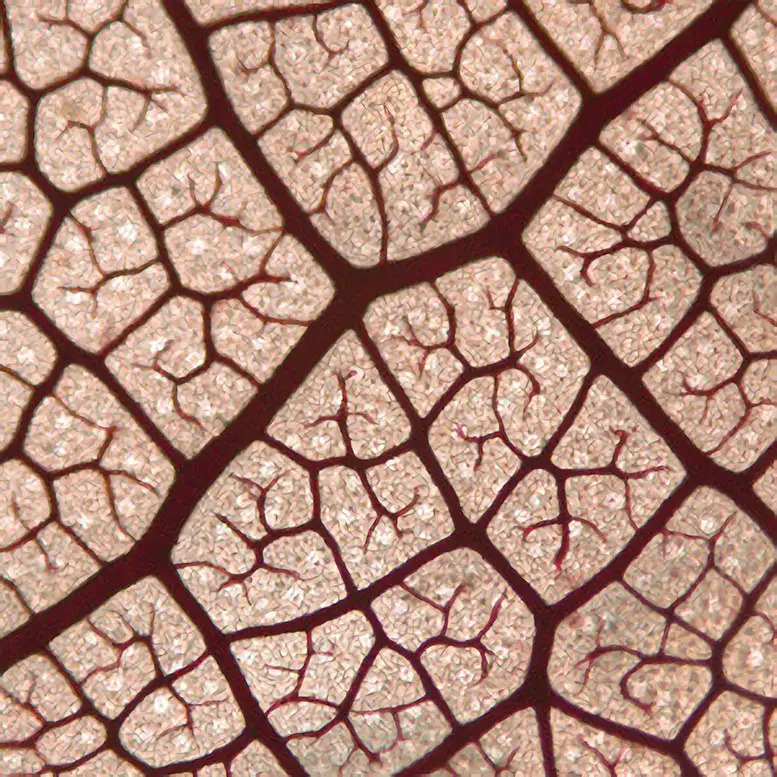
Abstract: We characterize the lower and upper attainability of the Wiener bound (also known as the conductive analogue of the Voigt-Reuss-Hill bound in elasticity theory) for singularly distributed conductive material mixtures. For the lower attainability we consider mixtures in which high-conductance materials support on sets having finite one-dimensional Hausdorff measures. We show that, under a mild coercivity condition, the kernel of the effective tensor of the mixture is equal to the orthogonal complement of the homotopy classes of closed paths in the supporting set. This shows that a periodic planar network has positive definite effective tensor, i.e., it is resilient to fluctuations, if and only if the network is reticulate. We prove a geometric characterization of the upper attainability by applying a transformation from varifolds to matrix-valued measures. We show that this transformation leads to an equivalence between two distinct notions from material science and geometric measure theory respectively: conductance maximality and area criticality. Based on this relation we show a pointwise dimension bound for mixtures that attain the upper Wiener bound by applying a fractional version of the monotonicity formula for stationary varifolds. This dimension bound illustrates how the maximality condition constrains the local anisotropy and the local distribution of conductance magnitudes. Both the lower and upper attainability results have potential novel applications in modeling leaf venation patterns.
Keywords: Homogenization, Wiener bounds, effective conductivity, varifolds, leaf venation patterns
Homogenization of a vertical oscillating Neumann condition
Joint with William Feldman, Archive for Rational Mechanics and Analysis, DOI: 10.1007/s00205-026-02188-2
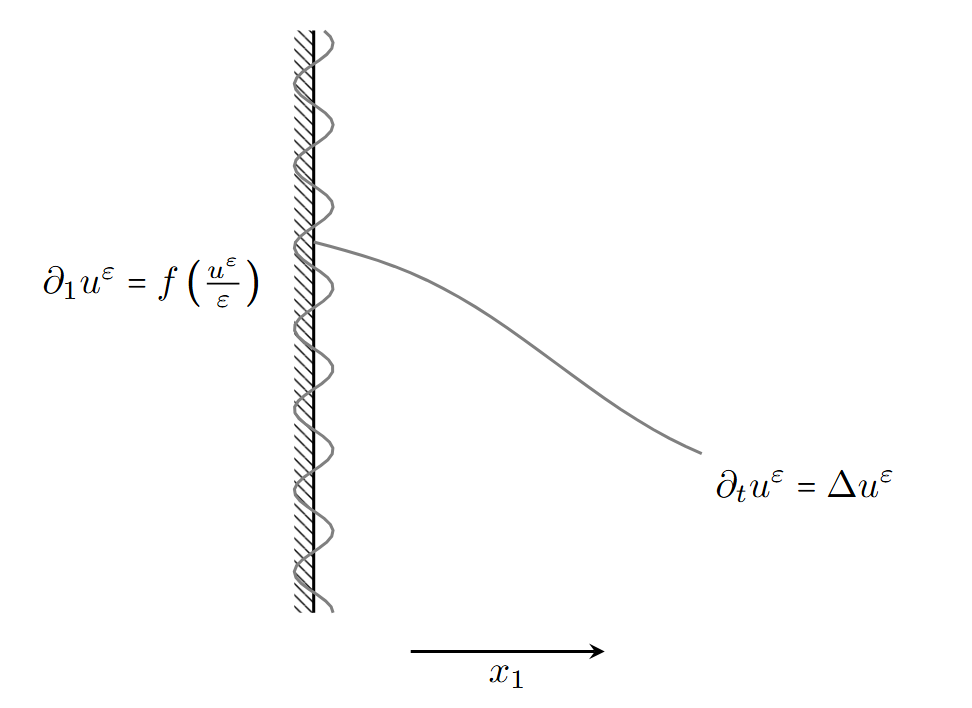
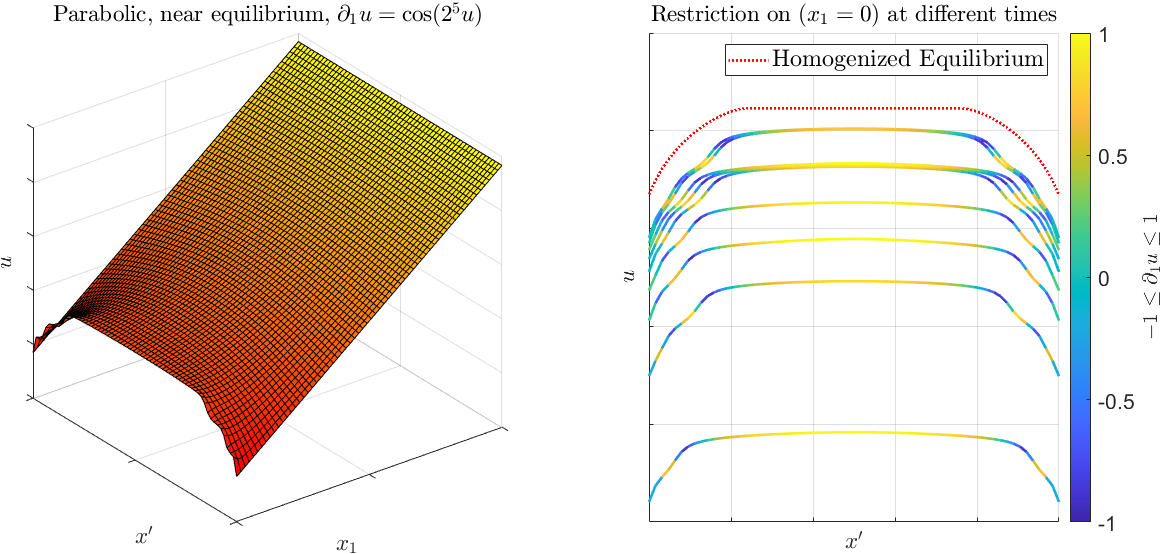
Abstract: We homogenize the Laplace and heat equations with the Neumann data oscillating in the "vertical" u-variable. These are simplified models for interface motion in heterogeneous media, particularly capillary contact lines. The homogenization limit reveals a pinning effect at zero tangential slope, leading to a novel singularly anisotropic pinned Neumann condition. The singular pinning creates an unconstrained contact set, generalizing the contact set in the classical thin obstacle problem. We establish a comparison principle for the heat equation with this new type of boundary condition. The comparison principle enables a proof of homogenization via the method of half-relaxed limits from viscosity solution theory. Our work also demonstrates, for the first time in a PDE problem in multiple dimensions, the emergence of rate-independent pinning from gradient flows with wiggly energies. Prior limit theorems of this type, in rate-independent contexts, were limited to ODEs and PDEs in one dimension.
Keywords: Homogenization, oscillating Neumann data, pinning, free boundary, viscosity solutions
Regularity theory of a gradient degenerate Neumann problem
Joint with William Feldman, Journal de Mathématiques Pures et Appliquées, Volume 209, May 2026, 103863
Abstract: We study the regularity and comparison principle for a gradient degenerate Neumann problem. The problem is a generalization of the Signorini or thin obstacle problem which appears in the study of certain singular anisotropic free boundary problems arising from homogenization. In scaling terms, the problem is critical since the gradient degeneracy and the Neumann PDE operator are of the same order. We show the (optimal) \(C^{1,\frac{1}{2}}\) regularity in dimension \(d=2\) and we show the same regularity result in \(d\geq 3\) conditional on the assumption that the degenerate values of the solution do not accumulate. We also prove a comparison principle characterizing minimal supersolutions, which we believe will have applications to homogenization and other related scaling limits.
Keywords: Free boundary problem, Signorini problem, regularity theory, comparison principle, gradient degeneracy
Is mean curvature flow a gradient flow?
Proc. Amer. Math. Soc. 154 (2026), 2617-2633
Abstract: It is well-known that the mean curvature flow is a formal gradient flow of the perimeter functional. However, by the work of Michor and Mumford [7,8], the formal Riemannian structure that is compatible with the gradient flow structure induces a degenerate metric on the space of hypersurfaces. It is then natural to ask whether there is a nondegenerate metric space of hypersurfaces, on which the mean curvature flow admits a gradient flow structure. In this paper we study the mean curvature flow on two nondegenerate metric spaces of simple closed plane curves: the uniformness-preserving metric structure proposed by Shi and Vorotnikov [11] and the curvature-weighted structure proposed by Michor and Mumford [8], and prove that the mean curvature flow is not a gradient flow in either of the spaces.
Keywords: Mean curvature flow, gradient flow, metric space of curves, calculus of variations
Homogenization of enhancing thin layers
Journal of Differential Equations, Volume 282, 2021, Pages 330-369
Abstract: This paper derives an explicit formula for the effective diffusion tensor by using the solutions to some effective cell problems after homogenizing Road effective boundary conditions (EBCs). The concept of Road EBCs was proposed recently by H. Li and X. Wang, and in this paper, we extend the effective conditions on closed curves to those on patterns, especially on the included nodes. We also prove that homogenization process commutes with the derivation of Road EBCs. By analyzing the effective diffusion tensor, we obtain several rules for maximizing its trace with given Road-effective-diffusivity/scale and length/scale in each cell and define a notion of balanced patterns. Moreover, we give an estimate of the trace of effective diffusion tensor of general patterns as Road-effective-diffusivity/scale goes to infinity.
Keywords: Homogenization, effective boundary conditions, diffusion tensor, thin layers, reaction-diffusion